
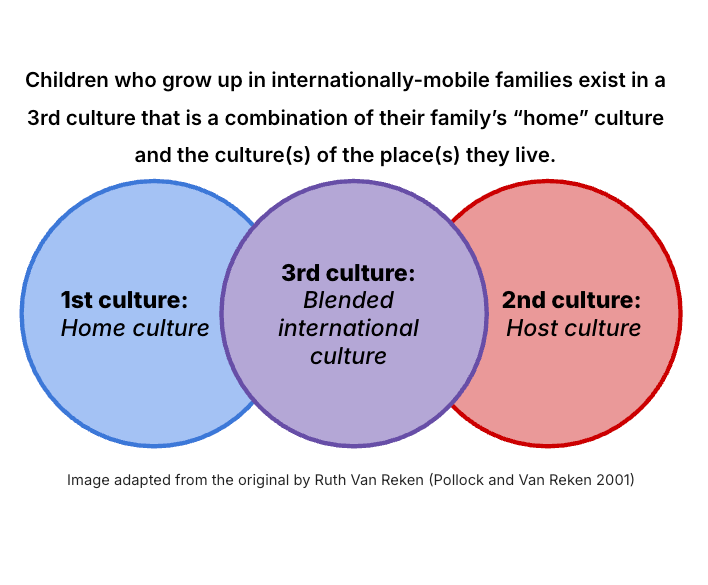
Third culture kids (TCKs) are often described in terms of transitions: multiple countries, schools, and cultural contexts. I should know. I’m the parent of three children, and they’re all TCKs, each with their own unique combination of geographies, experiences, and life stories. Two of them have used their stories to gain entry into schools that fit them well (the third is still in primary school – he still has plenty of time to write his own story).
In university admissions, this mobility can be re-framed as a distinct and compelling advantage.
Defining the TCK Profile
A Third-Culture Kid, or TCK, is typically a student who has spent a significant portion of their developmental years outside their parents’ home culture or cultures. This results in a blended identity shaped by multiple influences. TCKs may identify with parts of each parent’s “home” culture as well as aspects of the places they have lived, but they have enough life experiences outside of each of those that they don’t really qualify as a “typical” kid in any of them. While this can create complexity, it also fosters adaptability, resilience, and global awareness.
Admissions Value of Cross-Cultural Competence
Universities are increasingly looking for students who can contribute to diverse global communities. TCKs often demonstrate that they are comfortable navigating cultural differences. TCKs frequently have multilingual or cross-linguistic abilities, and because of their exposure to so many different people from so many places, they are often open to new perspectives.
These qualities align closely with institutional priorities when selecting students for admission.
The Challenge: Articulating Identity
The advantage of being a TCK isn’t automatic. One of the most common challenges is fragmentation. Students sometimes struggle to present a coherent sense of self. My middle child experienced this profoundly: after living in eight different countries on three continents, it took her a long time to be able to identify “home” and succinctly articulate who she is.
Effective university applications require synthesis: connecting disparate experiences into a unified narrative that creates a clear picture of the unique being each student is at their core.
Strategic Positioning in Applications
When developing their personal narratives, students should consider:
- Common themes across experiences (e.g., adaptability, curiosity, service)
- Moments of transition and growth that provide opportunities for reflection
- Avoiding superficial descriptions of travel in favor of deeper insight
That’s where I come into the picture.
My Role as a University Counselor for Third-Culture Kids
For TCK students, counseling often involves guided reflection. My goal is to help them move from “I have lived in many places” to “Here is how those experiences have shaped how I think, how I learn, and how I can contribute to the [University X] community.”
Being a third culture kid isn’t simply a background detail. Most importantly, it’s central to identity. It’s also a powerful narrative asset for the university admissions process. When articulated with clarity and depth, it can distinguish an applicant in highly competitive admissions processes.
Comments are closed